OpenELA – Open Enterprise Linux Association Website
A clean, authoritative Hugo website for the Open Enterprise Linux Association, communicating open governance, ecosystem value, and community trust.
View Live Site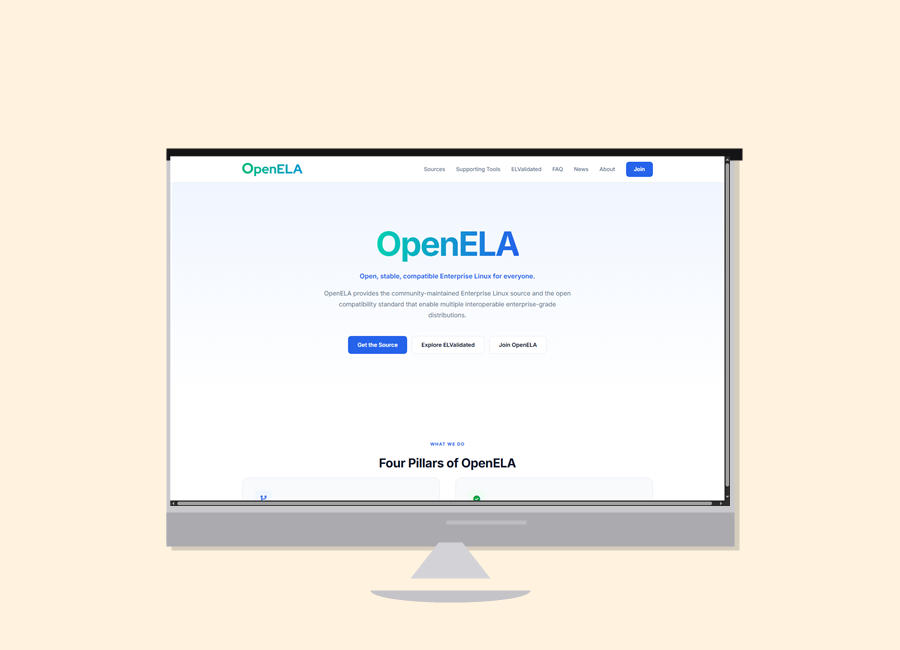
OpenELA – Open Enterprise Linux Association Website
OpenELA is a trade association founded by CIQ, Oracle, and SUSE to ensure Enterprise Linux remains open, stable, and freely available. They needed a website that would serve as the public face of the initiative, communicating the mission to developers, ISVs, IHVs, and enterprise decision-makers while establishing credibility as a neutral, community-driven organization.
The result is a clean, content-rich Hugo site organized around four clear pillars: providing the authentic Linux source, maintaining a compatibility standard, offering supporting tools, and operating under open governance.
OpenELA – built with Hugo
The Challenge
OpenELA sits at the intersection of open source community, enterprise software, and industry politics. The website had to navigate several competing demands:
- Multi-stakeholder messaging, the site serves ISVs, IHVs, developers, and enterprise buyers, each with different concerns and levels of technical depth
- Neutrality and trust, as a joint effort of three major Linux vendors, the site had to feel like a genuine community initiative, not marketing for any single company
- Technical depth without intimidation, Enterprise Linux source code, ABI compatibility, and OS migration tooling are complex topics; the site had to be accessible to technical decision-makers without oversimplifying
- Ecosystem credibility, the ELValidated compatibility standard and validated distributions (Rocky Linux, Oracle Linux, Liberty Linux) needed prominent placement to demonstrate real-world adoption
- Governance transparency, open source projects succeed on trust; governance documents, contribution paths, and community norms had to be front and center
The Approach
Content Architecture
The site is structured to serve both quick browsers and deep researchers. The homepage provides a complete overview, while dedicated pages offer depth for each area.
| Section | Purpose |
|---|---|
| Home | Mission, four pillars, stakeholder value, validated distros, CTA |
| Sources | Source repositories, build instructions, release tags |
| Supporting Tools | Leapp (OS migration), Mothership (source archive), documentation |
| ELValidated | Compatibility standard details, validated distributions, test suite |
| FAQ | Common questions about governance, source access, and participation |
| News | Announcements, blog posts, project updates |
| About | Organization background, founding members, leadership |
| Join | Membership information, contribution guidelines |
Design Philosophy
The visual identity needed to feel open, modern, and enterprise-grade, like the Linux ecosystem itself.
- Clean, technical aesthetic, a dark header with light content areas creates a professional, developer-friendly feel
- Orange accent color, warm, energetic accent that nods to the open source community without copying any single distro’s brand
- Four-pillar card layout, the core value proposition is presented as four equally-weighted cards, reinforcing the message of balance and completeness
- Stakeholder-specific messaging, the “Value for Every Stakeholder” section lets each audience self-identify and find their relevant content
- Partner logos, CIQ, Oracle, and SUSE logos are displayed prominently but tastefully, establishing credibility without overwhelming the content
- SVG icons throughout, custom icons for each pillar, tool, and stakeholder add visual interest without slowing page loads
- Clean typography, large headings for scanning, comfortable body text for deep reading
Technical Implementation
Built with Hugo for uncompromising performance and simple content management:
- Modular homepage sections, each pillar, stakeholder group, and validated distro is a reusable partial; content can be reordered or extended without touching templates
- News section, blog-style announcements with tags and date-based organization
- FAQ with structured data, FAQ schema for rich search results
- ELValidated page, dynamic display of validated distributions with partner logos and compatibility status
- Source repositories integration, links to GitHub org and individual repos organized by project
- Governance documents, linked directly from the site with clear contribution paths
- Responsive design, fully optimized for all devices, with particular attention to code-heavy pages
SEO & Performance
- Perfect Lighthouse scores for performance and accessibility
- Strong technical SEO for Enterprise Linux, ELValidated, and related keywords
- Open Graph and Twitter card meta tags for news and content sharing
- Organization schema with founding member markup
- Clean URL structure with sitemap
- Fast static delivery via CDN
Highlights
- Four-pillar messaging, the core value proposition (source, standard, tools, governance) is clear, memorable, and consistently reinforced across the site
- Stakeholder-specific value, ISVs, IHVs, developers, and enterprises each see themselves in the site’s messaging with relevant benefits called out explicitly
- Ecosystem validation, the validated distributions section with partner logos provides immediate social proof that OpenELA is real and adopted
- FAQ as onboarding, common questions about source access, governance, and membership are answered openly, reducing barriers to participation
- Governance-first, links to governance documents and contribution guidelines are never more than one click away, reinforcing the commitment to transparent community operation
- Developer-ready, source repositories, build instructions, and technical documentation are easy to find for those who want to dive in
Tech Stack
- Hugo, static site generator for speed and security
- HTML/CSS, clean, semantic code with CSS custom properties
- Vanilla JavaScript, navigation, smooth scroll, minimal interactivity
- CDN hosting, fast global delivery via Netlify
- GitHub integration, source repository links and organization profile
My Role
- Discovery & strategy, stakeholder interviews with founding member representatives, audience mapping for the Enterprise Linux ecosystem
- Information architecture, structured four-pillar model, content hierarchy across eight sections, news taxonomy
- Visual design, full UI design, color system, icon library, responsive layout
- Front-end development, Hugo theme customisation from scratch, modular partials, responsive CSS architecture
- Content architecture, structured pillar descriptions, stakeholder value propositions, FAQ content
- SEO & performance, technical keyword strategy, organization schema, Lighthouse optimization
- Launch & handover, deployment pipeline setup, content management documentation for the OpenELA team
Roadmap & Future Plans
The site launched as a comprehensive v1 covering all core messaging and content. Planned enhancements include:
Phase 2, Interactive ELValidated Dashboard
- Real-time compatibility test results for validated distributions
- Historical test data showing compatibility over time
- Self-service test submission for new distributions seeking validation
Phase 3, Community Hub
- Contributor directory and recognition
- Community forum integration
- Event calendar for meetups, conferences, and working group sessions
Phase 4, Documentation Portal
- Comprehensive documentation with versioned content
- Build guides and migration tutorials
- API reference for ELValidated tooling
Phase 5, Membership Portal
- Self-service membership application and renewal
- Member directory with organization profiles
- Voting and governance participation tools
The modular Hugo foundation makes each phase straightforward to add. OpenELA can prioritize what matters most to their growing ecosystem.
Live Site
Visit: https://openela.org/